Muslim Lehenga: Modest Fashion, Cultural Significance & Style Guide for Every Occasion
By Hijabi Bridal Team · ·
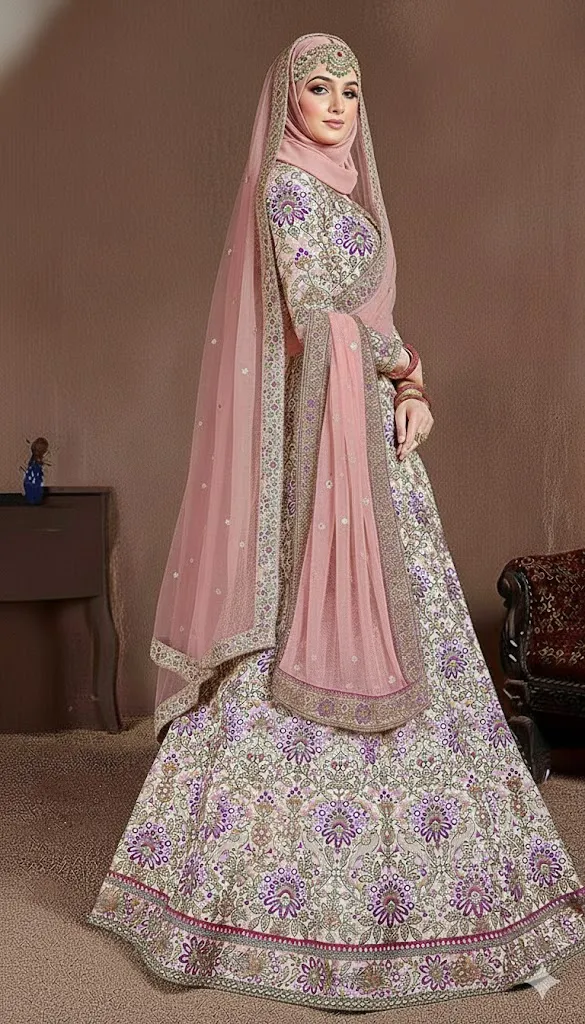
As a bride planning your wedding look, understanding the Muslim lehenga opens a window into a rich tradition that has been evolving for centuries. This guide covers everything you need to know — from its historical roots and cultural significance to today's most exciting fashion options — so you can dress confidently at your Muslim wedding.
What Is a Muslim Lehenga?
A Muslim lehenga is a traditional flared-skirt ensemble designed to align with Islamic principles of modesty. Unlike the Indian lehenga, which often features a short blouse (choli) that exposes the midriff, the Muslim lehenga pairs the same flowing skirt with a longer blouse or tunic — typically reaching the hips or even falling below the knee — so that the stomach is fully covered at all times. This single modification transforms the garment into something that honors the Islamic dress code while preserving the elegance and grandeur that have made the lehenga one of South Asia's most beloved garments.
The Muslim lehenga is not a compromise. It is a celebration. It carries the same intricate embroidery, the same luxurious fabrics — silk, velvet, georgette, net — and the same breathtaking silhouette as any other lehenga, but it is thoughtfully constructed so that a Muslim lady can wear it with confidence on special occasions like weddings and Eids.
Can Muslims Wear Lehenga?
Muslim women wear Muslim lehengas as traditional clothing for brides. The key is the word Muslim, so the permissibility lies in how the outfit is styled. According to Islamic clothing laws, modest fashion should cover the body without being form-fitting or revealing. As traditional clothing, the Muslim lehenga achieves this because the blouse or shirt is long — sometimes hip length, but it can actually fall under the knee or even be connected to the skirt as a bodice. This is unlike the Indian lehenga with the exposed midriff.
In South Asian culture, the lehenga as ethnic wear is based on silhouette. Even a maxi dress with the same, flared mermaid-type silhouette fits the technicality of a Muslim lehenga, which is why often times the blouse is connected to the skirt when customizing a lehenga. When the midriff and back are covered and the sleeves are modest, the lehenga becomes fully compliant with the Islamic clothing laws and emerge as diversity in fashion. 2026 wedding attire fashion trends have more fashion inclusivity and cultural sensitivity when it comes to modest fashion, which is trending in all realms, not just bridal. Modest fashion has never been more diverse and the Muslim lehenga is perfect for cultural exchange with others who prefer modest bridal wear.
Many Muslim brides pair their lehenga ethnic wear with two dupattas, one worn over the hijab and the other over the arm or shoulder, completing the look in a way that is culturally stunning. Today's Muslim lehenga comes in dozens of styles. Minimally embroidered looks promote cultural exchange and are the Muslim fashion trend in America for 2026 over the heavy embroidery of traditional bridal lehengas. Silks, satins, georgette and layered chiffon are used more for lehengas on this side of the ocean. The fashion options available to Muslim women shopping for a lehenga — whether online or in boutiques — are genuinely expansive, and the results are breathtaking.
Is lehenga a Muslim dress?
The cultural significance of the lehenga begins in the Islamic Mughal courts of the Indian subcontinent. Mughal royalty and nobility developed a distinctive Muslim dress that blended Persian Islamic aesthetics with indigenous South Asian textile traditions. The long blouse — the defining feature of the Muslim lehenga — was a hallmark of Mughal-era wedding traditions, distinguishing it from current Hindu styles. As Muslim attire, the lehenga is not merely a fashion detail; it is a living artifact of cultural exchange in South Asian fashion.
As modest clothing, this cultural outfit now extends far beyond history. In Indian clothing and Pakistani fashion, the garment still remains central to wedding traditions. When a Muslim bride puts on this Muslim attire, she is connecting herself to a lineage of women who wore similar garments in similar moments of transition and celebration.
The cultural significance of this Eastern aesthetic has traveled with diaspora communities around the world. The Muslim lehenga with hijab has become part of Muslim bridal attire in the US. In South Asian culture, the dupatta typically covers the hair, but fashion trends in America within the Muslim community has added hijab to this festive wear for women. Truly multicultural, Islamic dress codes allow this cultural exchange between Arabs and South Asians, as the hijab as we know it today is Arab Islamic dress adopted widely in the US. So a Muslim lehenga with hijab is both South Asian culture and Arab tradition. The cultural significance of this mix is alive in global fashion trends and bridal boutiques in cities like Chicago, Houston, and Dearborn, Michigan, where Muslim lehenga designs now reflect both South Asian roots and American modernity in the form of hijab.
How to Wear a Bridal Muslim Lehenga with Hijab
- Pinned to the back: Because hijab isn't part of South Asian culture, many brides disguise the Arab form of Islamic dress code while still keeping their hair, neck and ears covered. This is done by choosing a hijab that's close in color to the Pakistani fashion dupatta, but not sheer. Then pinning the hijab to the back, while covering the ears, and overlaying the dupatta to the back as well, over the hijab, with the decorated border right at the hairline. At times the edge of the hijab in back is cut in a circular fashion to blend better with the dupatta. The neck is then covered separately with one or two elaborate chokers and maang tikka is worn on the forehead.
- Loose hijab: The loose hijab worn to the front is also in line with South Asian culture. This modest fashion covers the chest, neck and hair with one sweep over the shoulder, similar in fashion to how an opaque dupatta is worn daily. The jhoomar nikkah jewelry can be pinned to the side of the hijab and maang tikka worn beneath. Large earrings are also worn under the loose hijab and can still be seen. The bridal dupatta is worn over the arm or shoulder.
- Styled hijab: The hijab can also be styled in an elaborately pleated Arab style or simple, tucked in, Turkish style. This is the cultural exchange where Muslim lehenga with hijab stands out as just that, a very prominent mix of Indian clothing and other festive wear. Nikkah jewelry and dupatta can still be worn over this type of hijab, but it's still very visual as a Middle Eastern aesthetic.
Do Muslim Brides Wear Lehenga?
The lehenga is arguably the most popular form of the Islamic wedding dress for Muslim brides from South Asian fashion heritage in the US. Its dominance is not accidental: by connecting the bodice to the skirt, the structure is naturally compatible with the modesty requirements of Islamic wedding traditions in the US making its look very similar to a Muslim bridal dress that's flared at the bottom. The skirt is floor-length and full-coverage by default, the dupatta provides an additional layer of coverage over the head and shoulders, and the only element that requires intentional modification for modest wear is the blouse — and that modification is simpler and more elegant than most brides expect.
The key insight that makes a lehenga work as an Islamic wedding dress is in how the blouse is constructed. In traditional Indian attire from Hindus, the blouse is a short, cropped piece that sits at or above the waist and exposes the midriff between the blouse hem and the skirt waistband. For a Muslim bride, this is the one element that needs to change — and when it does, the result is remarkable. When the blouse extends into a fitted bodice that connects seamlessly to the skirt below, covering the waist and midriff entirely, the lehenga reads less like a two-piece set and more like a single floor-length gown. When the blouse and skirt are joined, or even if the blouse is hip length, this silhouette looks very similar to a Muslim bridal dress. The garment meets every Islamic modesty requirement, is cost-effective, available on Amazon for customization, and retains the full visual drama: the flared skirt, the embroidered surface, and one or two draped dupattas.
Customization is a part of Muslim wedding customs in the US, by which tailors add modesty to traditional Indian attire and US wedding gowns. It is a sort of cultural fusion that customizes an unstitched choli (blouse) piece into a bodice or hip length blouse that is culturally rooted, modesty-compliant, and costs around $200 on Amazon. Calf length, heavily embroidered cholis in South Asian fashion can cost upwards of $500, and are rarely available on Amazon. Readymade designs use cholis that are knee length rather than cropped. These are readily available and cost around $100. Both the customization approach and the long readymade blouses cover the body and produces a lehenga that is Islamic and upholds wedding traditions in Pakistani-American wedding trends.
Under Pakistani- and Indian-American cultural exchange, cultural fusion remains on full display in 2026 as minimal embroidery and white and pastel colors, instead of red, take the lead in US trends. Double dupattas, nikkah jewelry, and henna all remain fully intact. The mirror work, embroidery, and beadwork is all there, but minimalized, giving each look a distinct trending identity within the same modest silhouette.
In American Muslim wedding traditions, lehenga styles with long sleeves and extended blouses, have become one of the most photographed bridal looks precisely because they achieve something Western modest wedding attire often cannot: the feeling of being fully dressed for both a religious ceremony and a South Asian cultural celebration at once. The lehenga carries a flow that Middle Eastern bridal fashion does not — it is the garment of South Asian brides across generations since the time of the Islamic Mughal empire, but is open for brides from every background and culture. For interfaith wedding traditions, the dramatic visual presence in white, champagne, ivory, or pink communicates bridal formality to guests from every cultural background. And with cultural sensitivity in wedding planning for the modern Muslim couple of two different backgrounds, modest lehenga silhouettes in any preferred color are one of the most dynamic areas of cultural fusion in wedding fashion today.
Modest Fashion and the Muslim Lehenga
Modest fashion is one of the fastest-growing segments of the global fashion industry, and the Muslim lehenga sits squarely at its heart. Modest fashion — broadly defined as clothing that covers the body in line with religious or personal standards — has moved from niche to mainstream over the past decade. International fashion weeks now feature modest collections. Major retailers stock modest swimwear, occasion wear, and everyday clothing. And within this expanding universe, the Muslim lehenga has become a symbol of what modest fashion can be at its most majestic.
Modest fashion does not mean plain or restrictive. A Muslim lehenga for a bridal occasion might be crafted from deep red or emerald velvet, encrusted with zardozi (gold threadwork), and paired with matching dupattas that are draped elegantly. For a more casual Eid occasion, a lighter cotton or georgette Muslim lehenga in soft pastels offers breathable, festive beauty. The fashion options are as broad as any mainstream bridal or occasion market.
What sets modest fashion apart in the context of the Muslim lehenga is intentionality. Every design decision — sleeve length, neckline height, blouse hemline — is made with purpose. That purposefulness has produced some extraordinarily beautiful garments, and it's one reason why non-Muslim women attending South Asian weddings increasingly seek out modest lehenga styles for their guest attire as well.
Fashion Options: Styles, Fabrics, and Colors
The fashion options available in Muslim lehenga design are remarkably varied. Whether you prefer traditional embroidery or modern colors, there is a Muslim lehenga to suit your taste and the occasion at hand.
Fabrics
Silk and velvet are perennial favorites for bridal and formal occasion wear. Silk gives a fluid, luminous drape, while velvet brings richness and depth — ideal for winter weddings or evening celebrations. Georgette and chiffon are popular for lighter occasions like Eid gatherings or summer weddings, offering movement and airiness without sacrificing elegance. Net (fluid tulle) is frequently layered over heavier fabrics to add texture and dimensionality to the skirt.
Embellishments
Traditional embroidery techniques — zardozi, gota patti, mirror work, and resham (silk thread) — remain extremely popular for Muslim lehenga designs, especially for bridal occasions. These techniques are laborious and produce stunning results that cannot be replicated by machine. Modern fashion options also include digital prints, sequin panels, and abstract embroidery that blend contemporary and traditional aesthetics.
Colors
Red and maroon remais the iconic bridal colors across South Asian culture, but Muslim brides increasingly choose champagne, gold, sky blue, pink, and silver for their wedding lehenga. For Eid and other festive occasions, the full spectrum is on the table — pastels, jewel tones, neutrals, and everything in between. The fashion options in color are genuinely limitless.
The Muslim Lehenga for Different Occasions
The Muslim lehenga is an occasion-specific garment in the sense that it is typically reserved for events that call for elevated dress. Here is how the Muslim lehenga adapts across different types of occasions:
Weddings
The wedding occasion is the Muslim lehenga's natural habitat. Brides typically choose heavily embellished lehengas in rich colors, while wedding guests opt for slightly simpler styles that complement the bridal look without competing with it. A wedding occasion also calls for careful attention to hijab styling — a matching dupatta, a contrasting silk wrap, or a separately sourced chiffon hijab can complete the look.
Eid Celebrations
Eid is a joyful occasion that calls for festive but not necessarily bridal attire. Lighter Muslim lehenga styles in bright or pastel colors are perfect for this occasion. Many families make a tradition of purchasing a new Muslim lehenga for Eid al-Fitr or Eid al-Adha, adding cultural significance to the act of dressing up.
Cultural Festivals and Formal Gatherings
Any formal South Asian occasion — a mehndi ceremony, a walimah, or any cultural gala — is an appropriate occasion for a Muslim lehenga. These events provide a wonderful opportunity to experiment with fashion options that might feel too bold for everyday wear.
The Muslim Lehenga in the US Muslim Community
The US Muslim community is one of the most diverse in the world, encompassing people of South Asian, Arab, African, and Western backgrounds. Within this community, the Muslim lehenga holds a special place — particularly among those with roots in Pakistan, India, and Bangladesh. And the ornate look is catching on for indigenous cultures as well. Weddings and Eid celebrations in the US Muslim community frequently feature stunning Muslim lehenga looks that demonstrate how South Asian culture travels and transforms across generations and geographies.
The US Muslim community has also driven demand for better online shopping options. In the past, finding a quality Muslim lehenga in the United States meant either traveling abroad, relying on relatives visiting from South Asia, or visiting one of a handful of boutiques in cities with large South Asian populations. Today, online shopping has changed everything. Numerous e-commerce platforms specialize in modest South Asian fashion, and online shopping giants like Amazon carry an increasingly robust selection of Muslim lehenga styles. Online shopping has made it possible for a Muslim woman in a small Midwestern town to access the same fashion options as someone living in a major metropolitan area.
How to Style a Muslim Lehenga
- The blouse: As noted above, the blouse of a Muslim lehenga must be long enough to cover the stomach — at minimum to the hip, ideally to the knee for fuller coverage. Long sleeves are standard, though three-quarter sleeves with an undershirt are also a popular option.
- The dupatta: A dupatta styled with or as a hijab completes the modest look. The dupatta comes with a Muslim lehenga. As a bride, choose a second dupatta in a fabric that matches or contrasts with your lehenga. Chiffon, organza and georgette all drape beautifully as second dupattas, creating a distinct bridal look.
- Footwear: Traditional juttis (embroidered flat shoes) or heeled sandals are the classic choices. Platform sandals have become popular for bridal occasions as they add height without sacrificing comfort through a long event.
- Jewelry: Jewelry is where Muslim lehenga styling gets particularly joyful. Chandelier earrings, layered necklaces, stacked bangles, and maang tikka (headpieces) are all traditional and beloved accessories.
Where to Buy a Muslim Lehenga in the US
Online shopping is the most practical route for most US residents looking for a Muslim lehenga. Several dedicated modest fashion e-commerce sites offer curated selections of Muslim lehenga designs, with detailed size charts, fabric descriptions, and customer reviews. Online shopping platforms like Amazon also carry accessible options at comparatively low price points, making it easier than ever to find something for every budget and occasion.
Muslim Lehenga FAQs
Can Muslims wear lehenga?
Muslim women wear Muslim lehengas, the word Muslim making the distinction. A Muslim lehenga has a blouse or choli long enough to cover the stomach — at least hip length, though under-the-knee coverage is ideal in traditional clothing in South Asian culture. In the US, fashion trends for 2026 dictate minimal embroidery for the Muslim lehenga, which is usually heavily embroidered back home.
Is lehenga a Muslim dress?
The cultural significance of the lehenga begins in the Islamic Mughal courts of the Indian subcontinent. Mughal royalty and nobility developed a distinctive Muslim dress that blended Persian Islamic aesthetics with indigenous South Asian textile traditions. The long blouse — the defining feature of the Muslim lehenga — was a hallmark of Mughal-era dress, distinguishing it from current Hindu styles.
Do Muslim Brides Wear Lehenga?
The lehenga is arguably the most popular form of the Islamic wedding dress for Muslim brides from South Asian fashion heritage in the US. The key insight that makes a lehenga work as an Islamic wedding dress is in how the blouse is constructed at hip length, below the knee or connected to the skirt as a bodice.
Where can I buy a Muslim lehenga in the United States?
Online shopping is the most accessible option. Dedicated modest fashion e-commerce websites and platforms like Amazon offer a wide range of Muslim lehenga styles. South Asian bridal boutiques in major US cities are also an excellent resource, particularly if you want a custom-fitted garment for a bridal occasion.
Is the Muslim lehenga different from a Pakistani lehenga?
These terms often overlap. Pakistani lehenga styles frequently adhere to Islamic modesty standards by default, featuring longer blouses and full sleeves. The term "Muslim lehenga" specifically emphasizes the modest construction — the covered midriff and modest sleeves — that makes the garment consistent with the Islamic dress code, regardless of whether the design originates in Pakistan, India, or elsewhere.