Sharara Collection
What is the difference between gharara and sharara?
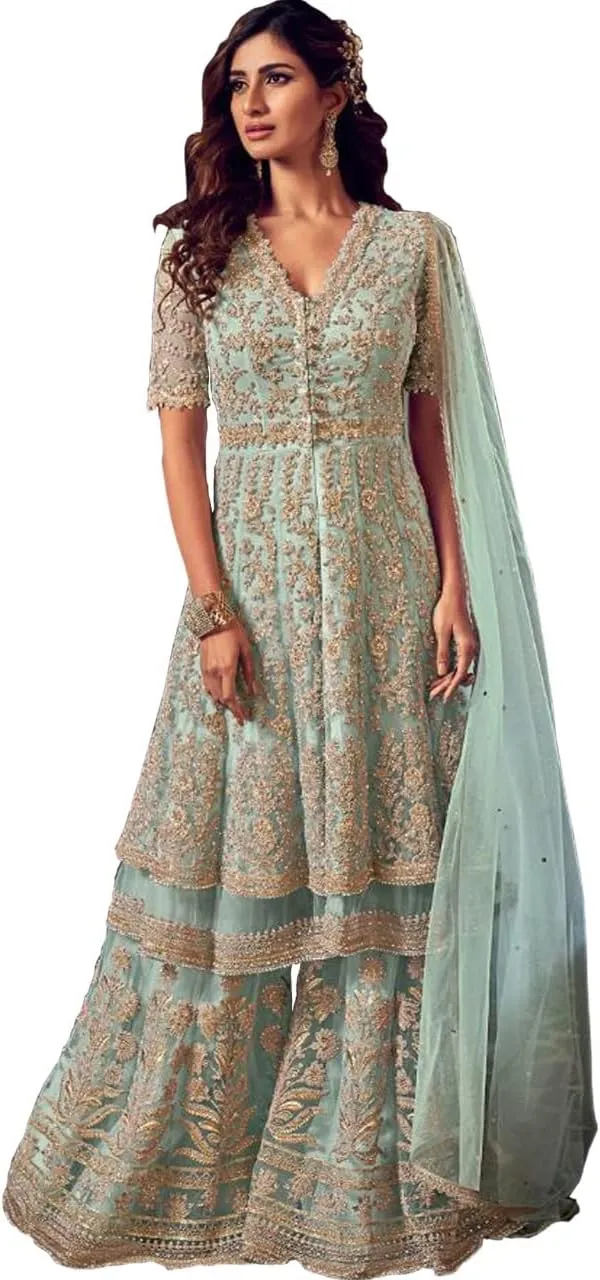
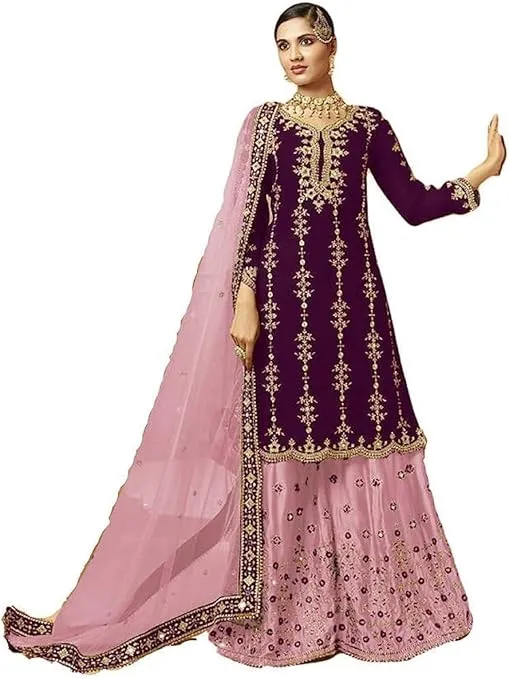
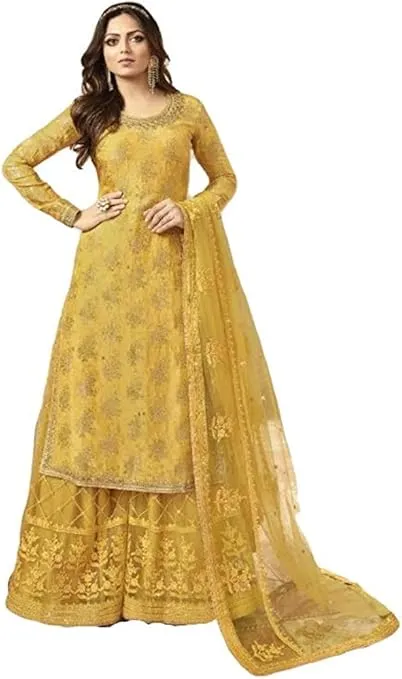
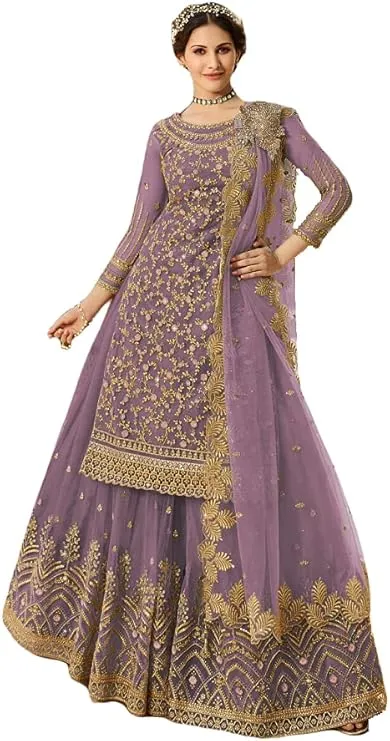
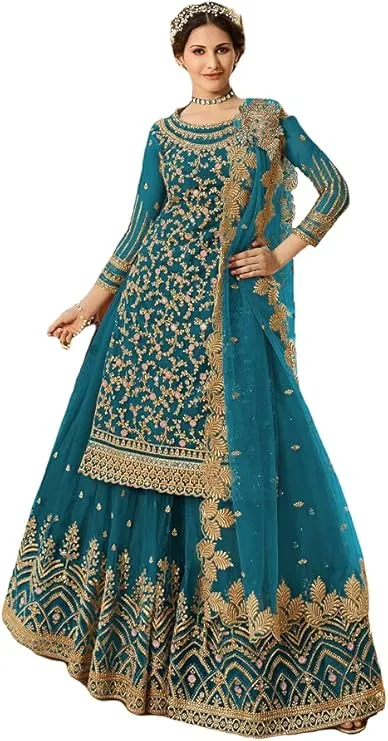
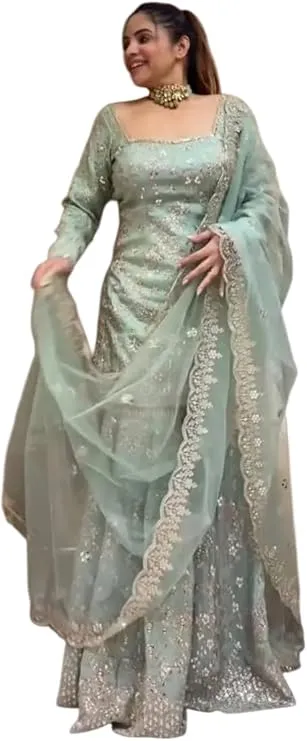
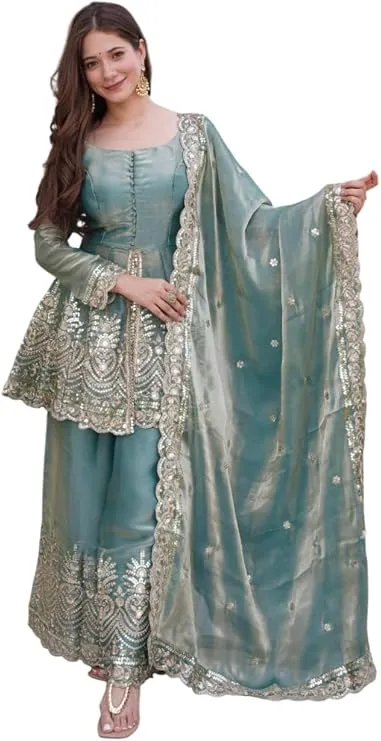
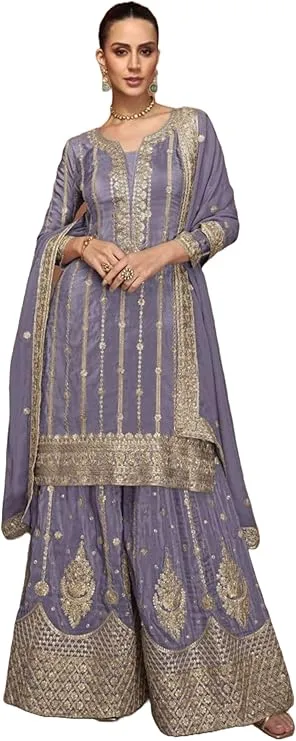
Sharara sets have pants with wide-legs that flare continuously from the waist to the floor — there is no seam break, no sudden change in silhouette. Gharara pants, by contrast, are fitted from the waist to the lower thigh, where a separate, heavily ruffled panel is attached. We have shararas and ghararas below to cover the full spectrum of South Asian style for hijabi brides. To learn more, READ MORE BELOW...
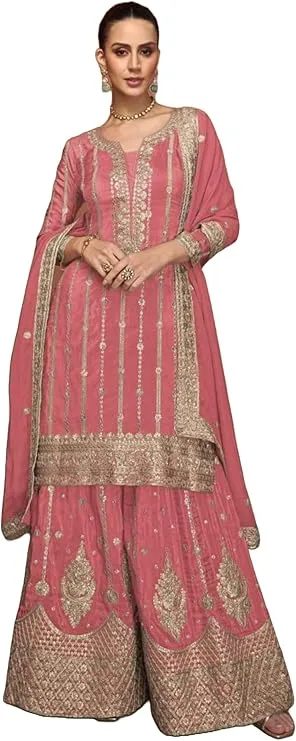
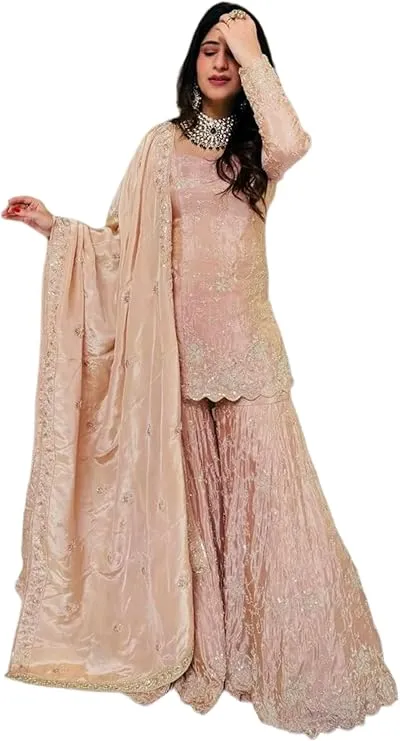
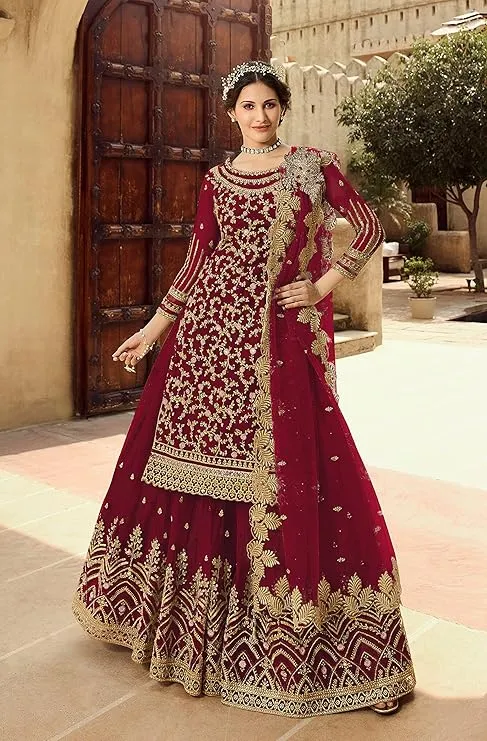
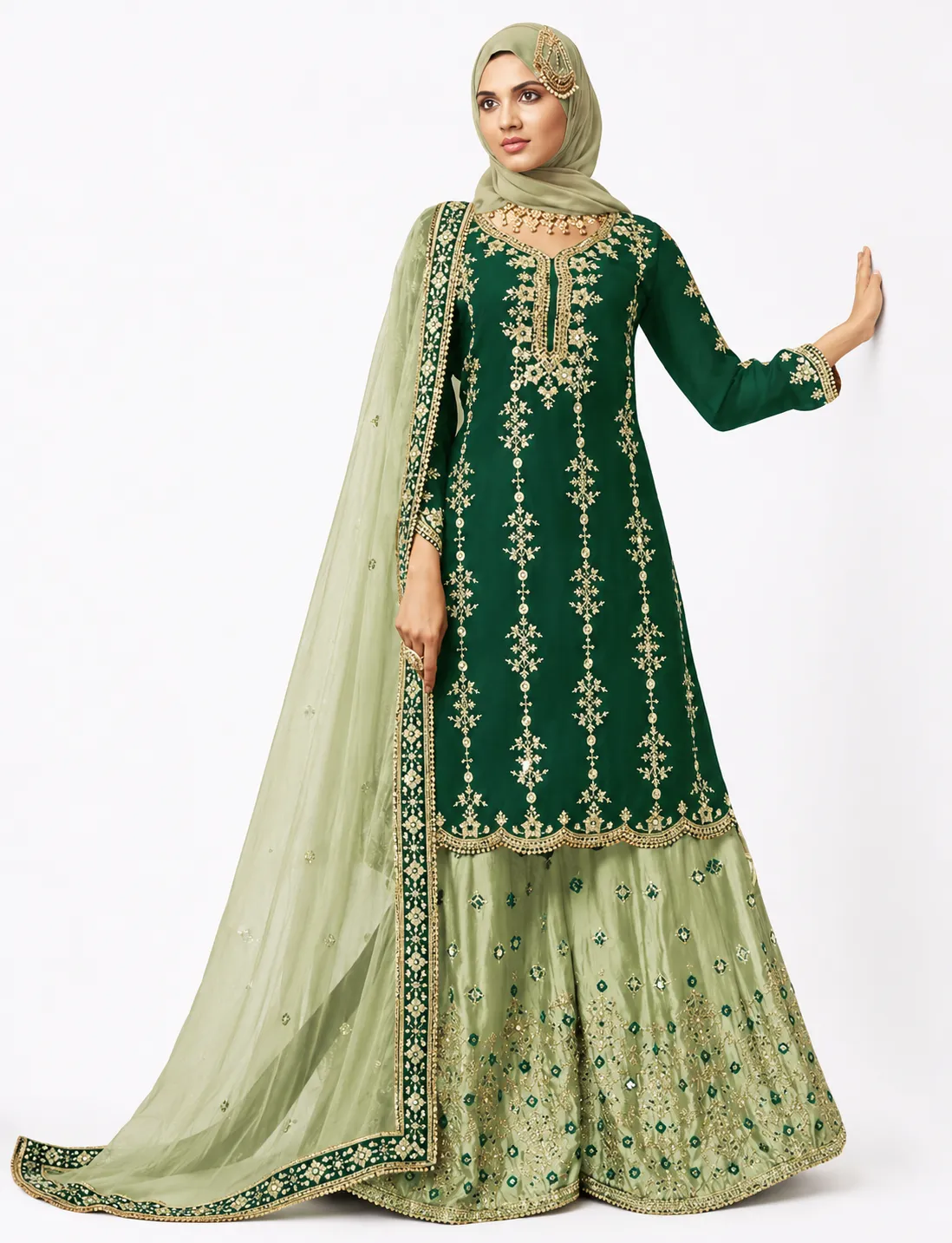
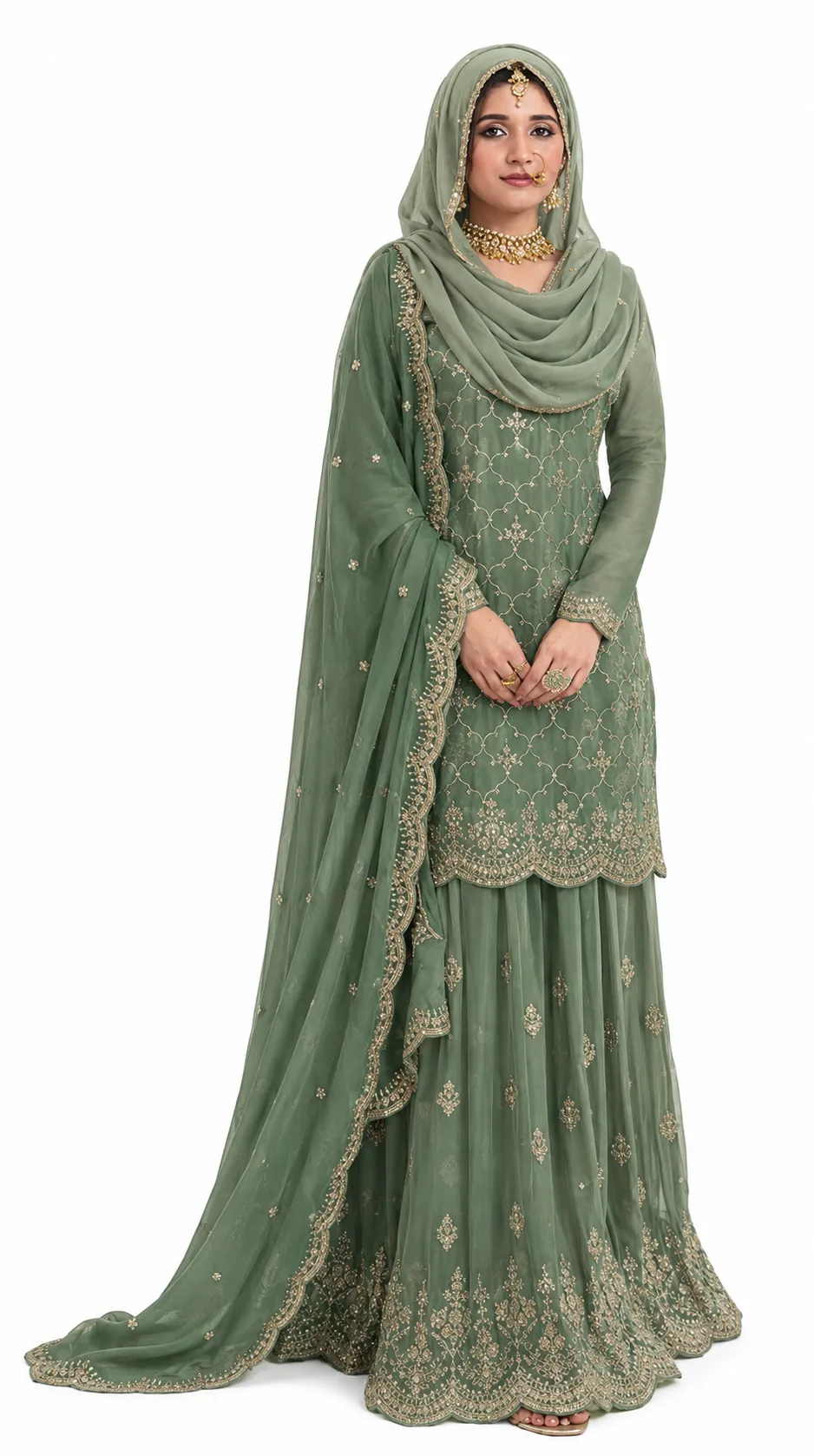
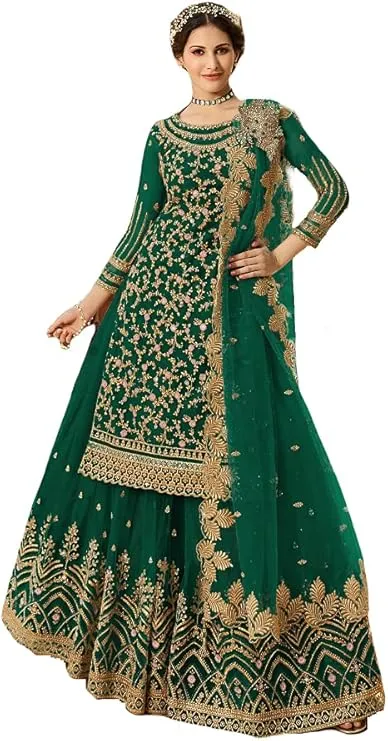
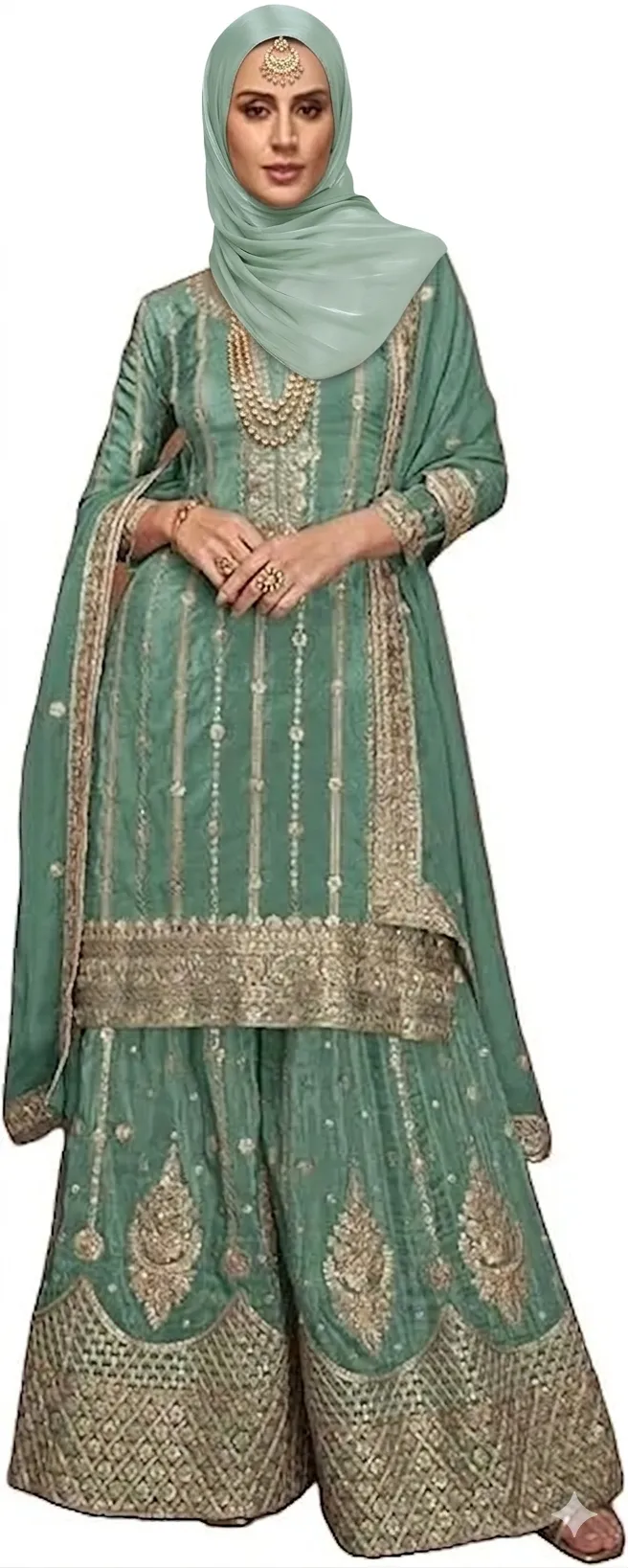
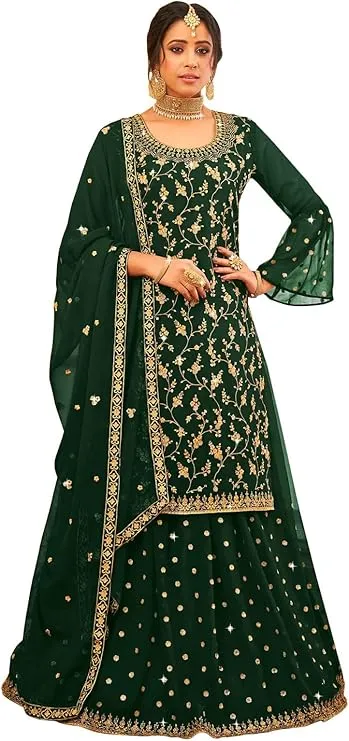
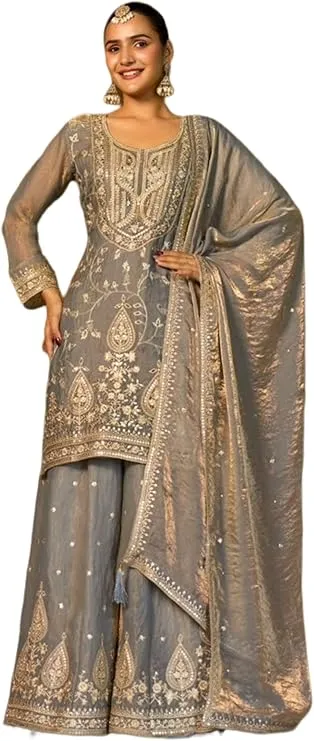
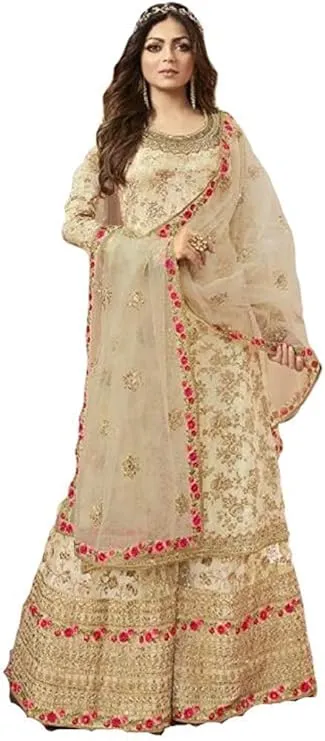
What is the difference between gharara and sharara?
Is it sharara or gharara? Well, sharara pants are one long, uninterrupted sweep of fabric that move with you. Gharara pants, by contrast, have a thigh-seam that is its defining feature, giving it a more structured, dramatic lower profile. Gharara and sharara are the same in that they are traditional attire styles rooted in Pakistani clothing and Indian fashion, with both featuring dramatically flared trousers, and both have been worn by women across the Indian subcontinent for centuries. But they are structurally distinct, and the difference matters when you are shopping for a wedding Sharara for a Muslim bride.
Both silhouettes have deep roots in Mughal court dress and are considered formal wear across the South Asian disaspora and US fashion trends alike. In the US, both terms surface regularly in bridal searches because Pakistani clothing and cultural influence have become a mainstream part of American wedding fashion — brides from Pakistani, Indian, Bangladeshi cultural influences and mixed-heritage backgrounds are all shopping for these silhouettes, and so are American Muslim brides drawn to modest fashion with an elegant aesthetic via cultural exchange. Sharara pants are the more accessible of the two for hijabi brides specifically, because the continuous flare from the waist works naturally with a longer tunic and dupatta without requiring the thigh-seam styling that can be a bit flirtatious.
For fashion blogging, the sharara suits as ethnic wear has seen a significant resurgence in 2026 editorial features precisely because its clean, unbroken silhouette photographs beautifully and translates well across both traditional South Asian wedding attire and the contemporary modest fashion aesthetic that US Muslim brides are building. Celebrity style across Bollywood Indian fashion and Pakistani drama has kept both garments visible in desi clothing and ethnic wear, but the sharara's simpler structure has made it the more wearable choice for brides who want the drama without the fitting complexity. Whether you call it Muslim clothing or traditional attire, it is one of the most flattering and versatile pieces in South Asian bottom wear today.
Understanding the structural difference also helps when browsing wedding dresses online, where gharara and sharara are sometimes used interchangeably by sellers. But is it sharara or gharara? A reliable way to distinguish these forms of bottom wear is to look at where the flare begins. If the fabric flares continuously from the waistband to the floor without interruption, it is a sharara set. If there is a visible seam at the thigh where a ruffled or pleated panel is attached, it is a gharara. Both the gharara and the sharara traditional attire appear at cultural festivals, walima receptions, and nikah ceremonies across the South Asian diaspora community, and both are legitimate, beautiful choices. The gharara's thigh panel creates more volume at the floor and a more theatrical silhouette overall; the sharara's continuous flare is cleaner and typically easier to walk and sit in across a full wedding day. For brides choosing between them for modest fashion at an American Muslim wedding, the sharara tends to photograph more cleanly across a wider range of venues. A gharara is the right choice when a bride specifically wants that dramatic ruffled lower panel and the Mughal-court aesthetic it creates — and the gharara's layered volume is particularly striking for large banquet hall events where the full sweep of the garment is visible. In US fashion trends, the cultural exchange of both the sharara and the gharara are increasingly visible as mainstream bridal options beyond the South Asian community alone.
Is sharara an ethnic wear?
The sharara set has its origins in South Asian fashion, specifically within the Mughal court tradition of the Indian subcontinent. It emerged as formal wear for women during the Mughal period, when Persian, Central Asian, and Indian influences blended into a distinct aesthetic that shaped Pakistani culture and Indian fashion for generations. The word itself derives from Persian, reflecting the cross-cultural textile industry and trade routes that ran through the region. So if you're wondering do Muslims wear sharara, the answer is a definite positive. Over time, the sharara became associated with wedding attire and cultural festivals — occasions where women wore their most elaborate traditional dress — and it has retained that association in both South Asian fashion and the US diaspora communities that carry these traditions forward.
Today, the sharara functions as a living piece of cultural heritage. Are sharara suits Indian? Not totally. In Pakistani culture specifically, this silhouette remains one of the most recognized pieces of women's attire for wedding events, from the nikah ceremony through the walima reception. In Indian fashion, particularly in North Indian and Mughal-influenced regional styles, it appears at weddings, Eid celebrations, and cultural festivals as a statement piece in embroidered clothing — silk, chiffon, and net with contemporary embroidery and modern color palettes. So do Punjabis wear sharara? Of course. Fashion designers across both countries — and increasingly in the US — have expanded its reach through desi fashion editorials and Eastern wear coverage that keeps the silhouette visible year-round.
For American women engaging with South Asian fashion through marriage, community, or personal interest, the sharara offers an entry point into traditional dress that feels both authentic and wearable. Its modest construction — a long tunic over wide-leg, floor-length pants — aligns naturally with Islamic traditions, which is why it has become a staple in the US Muslim bridal market. High-quality embroidered clothing from the Indian subcontinent is more accessible than ever for US brides, and the sharara is not a costume or a trend — it is one of the most enduring pieces of women's attire in South Asian cultural heritage.
The sharara's story also makes it one of the most meaningful garments to wear at an American Muslim wedding. Choosing a sharara kurta set is an act of cultural affirmation — it connects the bride to a lineage that stretches from Mughal court formal wear through Pakistani culture's most celebrated bridal traditions and into the contemporary modest fashion moment that US Muslim brides are shaping right now. The embroidered clothing traditions that define the sharara's surface — zardozi, gota patti, mirror work — each carry their own regional history and are recognized as Eastern wear of the highest artisan caliber. For a bride who wants her wedding attire to carry that kind of meaning alongside its visual impact, the sharara delivers both. For more on how <a href="https://textilelearner.net/velvet-fabric-properties/">South Asian textile traditions</a> shape the formal wear landscape that the sharara occupies, the craft behind these garments is as significant as their silhouette.
Does sharara suit a chubby girl?
Perhaps you're wondering can chubby girls wear sharara. Yes — and not just as a polite answer, but as a genuinely well-supported fashion reality. The sharara kurta set is one of the most consistently recommended silhouettes in plus-size fashion styles for Indian clothing for all body types, and for good reason. The flare begins at the waist and continues unbroken to the floor — no horizontal seam at the hip or thigh to draw attention to the widest part of the body. This is exactly the kind of structural fashion advice that body positivity advocates emphasize when discussing ethnic wear for curvy figures: the garment should move with the body in light fabric choices, not compress or bisect it.
What body type is a sharara suit best for? For chubby girls specifically, the combination of a longer tunic — which covers the hips and midsection — and the wide-leg flare below creates a continuous vertical line from shoulder to floor. That vertical emphasis is the cornerstone of flattering women's wear for fuller figures, and it is something that many other ethnic wear silhouettes struggle to achieve. Lehengas with heavily structured skirts can add bulk at the hip; churidar pants can cling in unflattering ways; palazzo suits can look shapeless without a kurta. A well-fitted sharara set in light fabric choices avoids all of these issues because its volume is intentional and evenly distributed. US fashion trends have increasingly validated this — plus-size fashion style coverage in bridal and South Asian spaces consistently highlights sharara suits as top-tier option for fashion inclusivity and curvy figures. And if you're wondering what body types look best in ghararas. It's the same as for sharara!
Self-esteem is not separate from fashion advice — it is the point of it. A sharara kurta set in the right fabric, properly fitted at the shoulder and waist, gives a chubby girl or any plus size woman the confidence to walk into a wedding feeling genuinely beautiful in clothing with cultural significance. Our collection covers this in women's apparel across extended sizes and multiple silhouettes, because body image and size inclusivity are not niche concerns — they are the standard. Indian clothing in the USA has made significant strides here, and modest dressing in South Asian fashion has followed suit.
The cultural significance of the sharara's rise in US modest fashion is also worth acknowledging. As South Asian fashion trends in the US become more visible, the sharara has traveled from specialist boutiques into mainstream modest fashion conversations — and body positivity has traveled with it. US fashion trends in the modest bridal space now consistently feature sharara suits alongside Western bridal silhouettes as an equal choice for every body type. Women's apparel from this tradition carries a built-in commitment to coverage that aligns naturally with modest dressing values, which is one reason the sharara's fashion inclusivity message resonates so broadly. For a bride who has spent years feeling underserved by Western bridal wear, Indian clothing in the US modest bridal market offers a genuine alternative — and the sharara as an expression of personal style is one of its most compelling ambassadors. Body positivity in bridal fashion is a standard, not a niche, and South Asian fashion in the US is proving it.
Is sharara two-legged?
Sharara and gharara are both two-legged pant styles, although to some these traditional clothing outfits appear like a skirt. The sharara is so full at the bottom that you have to look closely to see the two-legged division. The gharara flares from the bottom of the thigh, so unless the top is above the flare, it can also look like a skirt. However, when looking at two images of sharara vs gharara, the difference can be clearly seen, as the two-legged division in gharara is more clear.
The structure of sharara as cultural dress is meant to be a more comfortable version of bridal wear, which is typically long and weighty. While the pants can carry heavy embroidery at the bottom, it's not as burdensome as having allover embroidery. When worn with the traditional Pakistani double dupatta, it looks completely bridal, but more modern. In 2026, Pakistani bridal styles in the US have less embroidery and straight lines. The Punjabi sharara fits this ideal perfectly.
Gharara is traditional two-legged clothing that's part of South Asian fashion for eids and bridalwear alike. When worn with a shirt above the flare, it's a flirtatious form of cultural dress as it outlines the leg. First-time brides don't usually prefer this look, but it can be nice festive wear for guests.
Which is better, sharara or lehenga?
Although the two might appear the same with the lower flare, the difference between lehanga and sharara is that ghagra is a skirt, whereas sharara are pants. It's pretty easy to confuse this traditional wear because of the bottom flare, but if you look closely, the division of the pants is visible.
But is a sharara appropriate for a wedding? There are wedding sharara for brides specifically, and most of them are more heavily embroidered than, say, Eid sharara. And because pants are generally more comfortable and easy to move around in than a skirt, many brides prefer this form of wedding attire. As formal wear, it looks only slightly less dressy than a bridal lehenga, as there is no crinoline holding it to make it flare. Nevertheless, sharara are definitely a South Asian wedding tradition that's come back to trend in Pakistani wedding fashion for 2026-27.
What is the price of a heavy sharara set for Islamic bridal wear? Like most Indian wedding dresses and Pakistani fashion bridal outfits, the price varies by the outlet or designer. Wedding sharara for Muslim brides don't have the same structured silhouette and traditional design of a bridal lehenga and are therefore less costly. This form of Muslim wedding attire averages around $600-$700 for this formal wear, and lehengas can be double. If you're doing your wedding shopping online, the price can be less than at a boutique. But it really depends where you're buying. Heavy embroidery sharara sets on Amazon.com might only cost $250, but a designer name will cost much more, whether you buy it online or in a cultural clothing boutique.
Do Muslims wear sharara with hijab style?
Absolutely — and sharara hijab style is one of the most searched modest bridal aesthetics among Muslim women in the US right now. The sharara set is inherently compatible with hijab because its construction already meets the core requirements of Islamic modest dress: the tunic is long enough to cover the hips and often the thighs, the pants are wide-leg and non-form-fitting, and the set typically includes a dupatta that adds an additional layer of coverage. A Muslim bride wearing a sharara does not need to modify the garment to make it hijab-compatible — the garment was designed, historically and structurally, for exactly this kind of modest formal wear.
What sharara hijab style adds is the intentional coordination of the hijab with the rest of the bridal ensemble. The most common approach in our collection is to wear the dupatta in two ways simultaneously: one end is pinned over the hijab, falling to the back and framing the face with the embroidered border, while the second end is accordion-folded across one shoulder or tucked into a waistband. This double-drape technique is a signature of South Asian Muslim bridal styling and is what most brides mean when they search for sharara hijab style — not just covering the head, but creating a complete, layered bridal look where the hijab and dupatta work as one cohesive unit. A rhinestone hijab pin at the crown, jewelry layered over the hijab fabric, and a matching or contrasting bridal hijab in silk or chiffon all contribute to the finished sharara hijab style look.
For brides building their complete sharara hijab style, the fabric of the hijab matters as much as the garment itself. A heavy georgette or velvet sharara pairs best with a structured hijab in crepe or satin, which holds its shape through a full wedding day. A lighter net or chiffon sharara opens the door to softer, more fluid hijab fabrics that move with the outfit. We are expanding our collection to include sharara with hijab images across multiple colorways, so you can see exactly how each set looks styled as a complete modest bridal look — not just the garment in isolation, but the full sharara hijab style from head to toe.
Frequently Asked Questions
What is the difference between sharara and gharara pants?
Sharara pants are wide-leg pants in traditional attire that flare continuously from the waist to the floor with no seam break. Gharara pants are fitted from the waist to the lower thigh, where a separate ruffled panel is attached — the gharara's defining structural feature. Both are rooted in Pakistani clothing and Indian fashion as formal wear for wedding dresses and cultural festivals, but the sharara's unbroken silhouette is generally more practical for hijabi brides as gharara are a bit flirtatious.
What culture is sharara?
The sharara originates in South Asian fashion, specifically within the Islamic Mughal court tradition of the Indian subcontinent. It emerged as formal women's attire during the Mughal period, blending Persian, Central Asian, and Indian influences into a traditional dress style that has been central to Pakistani culture and Indian fashion for centuries. Today it is worn as wedding attire and at cultural festivals across South Asian communities worldwide, and it has become a prominent part of the US Muslim bridal market because its modest construction aligns naturally with Islamic dress standards.
Is sharara good for a chubby girl?
Yes. The sharara kurta set is one of the most flattering silhouettes in plus size clothing for South Asian ethnic wear. Because the flare begins at the waist and continues unbroken to the floor, there is no horizontal seam at the hip or thigh to draw attention to fuller areas of the body. The long tunic covers the hips and midsection, creating a continuous vertical line from shoulder to floor that is both slimming and elegant. Body positivity advocates in the US fashion market consistently highlight the sharara as a top recommendation for curvier women looking for Indian clothing in the USA.
Do Muslims wear sharara with hijab style?
Yes. Sharara hijab style is one of the most popular modest bridal aesthetics among Muslim women in the US. The sharara kurta set is inherently hijab-compatible — the tunic is long, the pants are wide-leg and non-form-fitting, and the dupatta provides an additional layer of coverage. Sharara hijab style typically involves wearing the dupatta in a double-drape: one end pinned over the hijab and falling to the back, framing the face with the embroidered border, and the second end folded across one shoulder or tucked at the waist. A matching bridal hijab in crepe, satin, or chiffon completes the look.