What Does a Muslim Bride Wear?
By Hijabi Bridal Team · ·
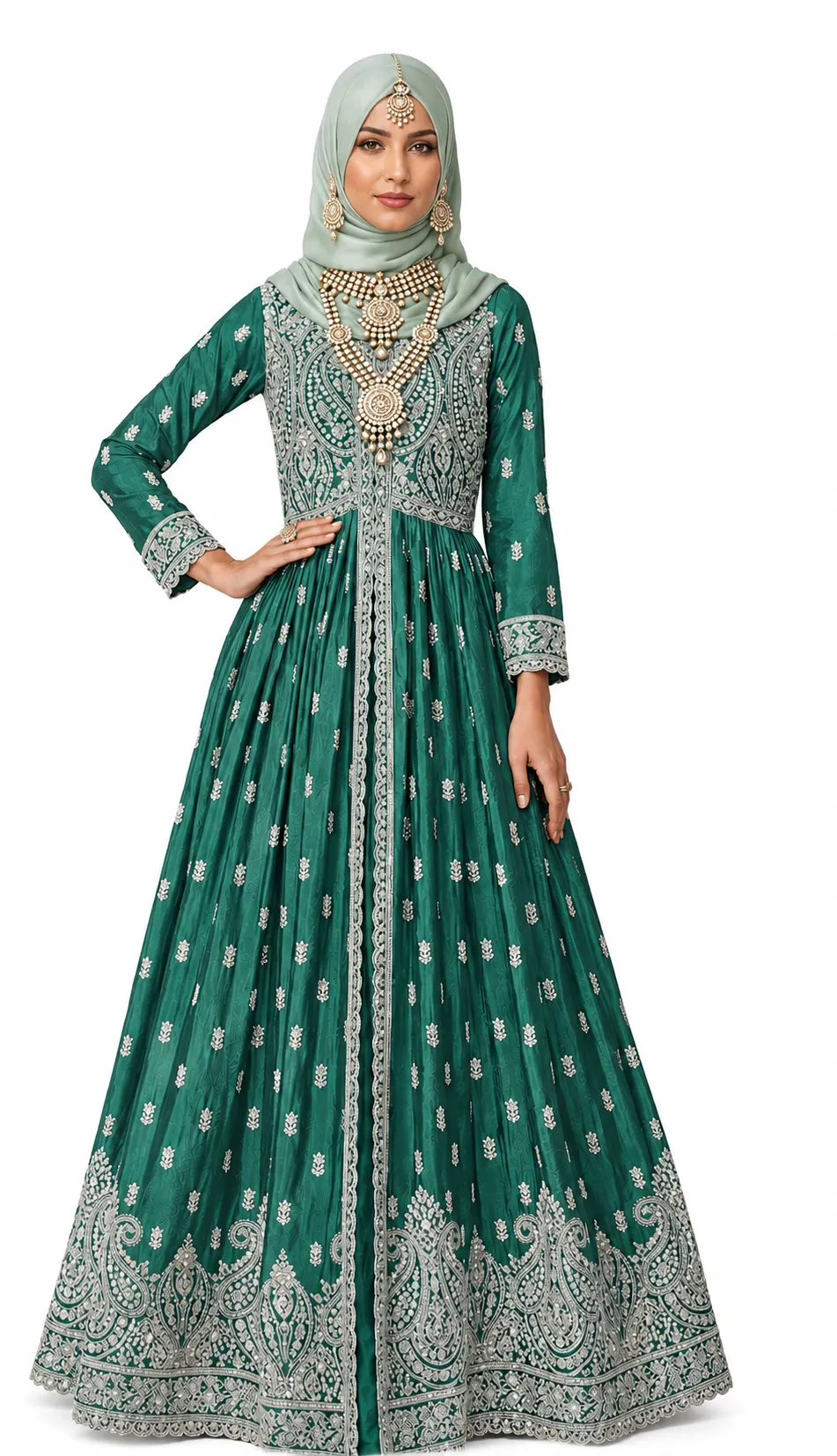
Wondering what does a Muslim bride wear on her wedding day? At the most essential level, a Muslim bride wears a Muslim wedding dress, lehenga, or sharara that honors Islamic principles of modesty to her wedding: the body should be covered, the fabric should not be transparent, and the overall style should not be form-fitting. Beyond that, religion sets the intention but nationality, culture, age, and family tradition shape every other decision. An Islamic bride coming from a South Asian culture in Houston may wear a red lahenga with traditional embroidery and a silk dupatta draped as a hijab. A bride who loves Middle Eastern fashion in New York may choose a flowing white abaya with long sleeves and elegant headwear. A Somali-American bride in Minneapolis may wear a richly colored dirac with gold embroidery and hijab and niqab. All of these are valid, beautiful expressions of Islamic wedding attire. In American Muslim wedding traditions, a Muslim bride wears whatever Muslim bridal dress reflects her faith, culture, and personal style — and that answer is genuinely broad.
What Does a Muslim Bride Wear to Her Wedding?
Whether she chooses a lahenga, an abaya, or a flowing sharara, religion is the primary factor that decides what the Islamic bride wears with her hijab. Islam is at the heart of Islamic wedding traditions, and the answer depends on a layered set of factors that no single image or style guide can fully capture.
What do brides wear at a Muslim wedding? Religion is the foundation.
Religion establishes the non-negotiables. In Islam, a woman’s awrah — the parts of the body that must be covered — includes everything except the face and hands. This means Islamic wedding attire must have long sleeves, a high or modest neckline, and a skirt or trouser cut that does not expose the legs. The fabric must not be sheer on her Muslim bridal dress with sleeves, or she should cover her arms using her wedding veil or bridal dupatta. The style must not be so fitted that the modest design becomes immodest. Beyond these requirements, religion leaves enormous room for beauty, luxury, and personal expression. A Muslim bride is encouraged to adorn herself on her wedding day, and the nikkah ceremony is a moment of joy and honor.
What does the bride wear in a Muslim wedding? Culture and nationality shape everything else.
Once religion establishes the framework, culture and nationality fill it with color, traditional embroidery, fabric, and style. The diversity within modest fashion trends across wedding attire in the US is staggering, and it is one of the most beautiful aspects of Islamic wedding customs in the US.
In South Asian culture — Muslims who are Pakistani-American, Indian-American, Bangladeshi-American — brides typically wear a lehenga, a sharara, or a heavily embroidered anarkali gown as their Muslim bridal dress with sleeves. Pakistani wedding traditions call for red or deep jewel tones, though champagne, blush, and ivory are increasingly popular. Embroidery in gold zardozi (metallic threadwork) is standard, and the headwear is almost always a dupatta worn over a hijab, similar to a wedding veil. In 2026, South Asian Islamic clothing has seen many brides use niqab as part of their modest wedding attire. The groom typically wears a sherwani in a coordinating color — and the sherwani’s embroidery is often chosen to echo the bride’s zardozi for a fully cohesive bridal couple look.
In Middle Eastern fashion, brides often wear gowns that blend Western silhouettes with Arab sensibility — long-sleeved, high-necked abaya-style dresses or wedding dresses in white, ivory, or blush, sometimes with intricate lace or beading. An abaya in silk or embellished chiffon with niqab, or face veil, is also a formal bridal choice in many Gulf-influenced families. Headwear may be a hijab in a matching fabric or a decorated piece pinned over the hair. The groom in Middle Eastern wedding customs often wears a thobe and a sherwani-influenced formal coat for South Asian Islamic clothing that is common in American Muslim wedding traditions.
West African and East African Islamic brides bring some of the most visually spectacular fashion to the Islamic wedding. Dirac, grand boubou, or heavily embellished kaftan styles in bold, saturated colors reflect the cultural significance of the bride’s location of origin. An abaya-inspired silhouette in East African Islamic dress traditions shares similar modest designs, floor-length coverage as a South Asian lehenga but in a completely different surface aesthetic. Headwear is often elaborate — wrapped turbans or decorated hijab styles that coordinate with the gown. The groom may wear an African style sherwani or traditional kaftan, and in West African communities a matching embroidered agbada and sherwani-length coat are both recognized formal choices.
Convert brides and American-born Muslim brides often create fusion looks — a Western-style Muslim wedding dress, modified for modesty, paired with a hijab in silk or chiffon and niqab as a Muslim bridal accessory. These brides are among the most creative in their approach to Islamic bridal attire, and cultural wedding dress designers in the US market increasingly cater to them. A Muslim wedding planner familiar with cultural exchange in the US takes this as one of the most valuable resources for brides navigating multiple frames of cultural significance, because Islamic wedding traditions in the US now encompass the full global breadth of modest wedding attire under one market umbrella. Interfaith wedding attire isn't excluded from this, although the bride be of a different faith.
Do Muslims Wear a Wedding Gown?
Muslims wear Western-style wedding gowns when they meet Islamic modesty requirements: full sleeve coverage, opaque fabric that does not reveal the shape of the body, and a neckline that does not expose the chest. Where a traditional Western gown falls short as a Muslim wedding dress — as many do — the solution is straightforward. A cape or coverup worn over the wedding gown addresses the body-shape concern entirely: a modest bridal cape in chiffon or velvet converts the silhouette into one that meets Islamic standards without altering the garment itself. This way the elegant bride remains fully covered in public.Browse our bridal cape collection for styles designed to coordinate with Western and fusion Muslim bridal looks.
A henna night, the ceremony, and a reception are three distinct occasions in many Muslim weddings, and brides often wear different looks for each. A Western-style gown might serve the nikah ceremony, while a South Asian wedding dress is reserved for the walima reception where a more culturally specific traditional Muslim wedding dress aesthetic is expected. The henna night typically calls for something lighter — often a lahenga or embroidered kurta in green or yellow. Middle Eastern wedding fashion has also contributed the kaftan aesthetic to the US Muslim bridal market — a Moroccan wedding caftan’s flowing silhouette requires no modification for modesty. Pakistani wedding dress culture and Indian Muslim wedding attire each bring their own embroidered traditions to this conversation.
Traditional Muslim wedding clothes vary dramatically by cultural background. A Pakistani wedding dress is not the same as Indian Muslim wedding attire, which is not the same as Middle Eastern wedding fashion, which is not the same as the Western-style gown a convert American Muslim bride might choose. All are culturally grounded answers. The Islamic bridal attire conversation in the US reflects that diversity, and Muslim brides are increasingly drawing from more than one tradition at once.
In the Islamic bridal attire context, the garment a Muslim bride wears for her nikah ceremony, walima reception, or both can be a South Asian wedding dress in silk and zardozi embroidery, a Western-style gown with modest modifications, a Moroccan wedding caftan, or a sleek abaya in ivory or champagne. Islam does not prescribe a specific silhouette for a Muslim wedding dress. It prescribes modesty — and modesty can be expressed through any of these forms.
What do you call a Muslim wedding dress?
Muslim wedding dresses for sale are called caftan or abaya styles in Middle Eastern fashion, and in traditional Pakistani or South Asian culture Muslim wedding dresses can be known as lehengas, shararas, or anarkali. The last option is the most universally worn, regardless of background, as a Muslim bridal dress with sleeves. The long sleeves and modest design make the anarkali Islamic bridal growns popular for nikah ceremonies and walima receptions by American brides, whether they are of South Asian culture or not. So if you're wondering what is the best Muslim bridal dress, it's the culture spanning anarkali.
What do Islamic brides wear? An Islamic bride will certainly wear hijab and sometimes a face veil as well. Muslim bridal dresses with sleeves are hijab friendly and are usually embroidered in an Indian inspired fashion, whether heavily or, in the modern take, lightly. Embroidered Islamic bridal gowns and Muslim wedding dresses are the most popular and universal look for US Muslims, whereas heavily embroidered bridal lehengas are traditional Pakistani bridalwear and Indian inspired wedding looks. Sharara is the more modern alternative to the lehenga due to its simpler cut and simple embroidered design. It's the double dupatta look worn with an anarkali Muslim wedding dress, lehenga, or sharara that make these long sleeve outfits truly stunning, whether lightly or heavily embroidered.
What should a Muslim bride wear? Fabric Choices
Fabric is one of the primary indicators of formality and investment in a Muslim bride dress. The most prestigious fabric choices for an Islamic bridal gowns are silk, raw silk, and velvet — materials that drape beautifully, hold embroidered surfaces without distortion, and photograph with exceptional depth.
Silk fabric in a bridal lahenga or abaya creates a luminous surface that elevates every embroidered detail. Velvet fabric is the dominant choice for fall and winter nikah ceremonies and walima receptions.— Its rich texture carries gold embroidery in a way that no other fabric replicates. Chiffon and georgette fabric are popular for lighter layers, dupattas, hijab, and Indian inspired summer wedding season looks, offering movement and airiness without sacrificing elegance.
Lace fabric has become increasingly popular among Middle Eastern fashion-minded and Western-influenced Muslim brides, appearing in long-sleeved wedding dresses and Islamic bridal gown overlays that add texture while maintaining modest designs. Satin fabric is a mid-range choice that delivers a smooth, polished finish for abaya and hijab at a lower price point than silk, and it is common in budget-conscious options for Muslim bridal dresses with sleeves.
What is a traditional Muslim wedding dress? Color Choices
Red is the traditional color for Muslim bride dresses across South Asian culture and parts of the Middle East, representing joy, celebration, and new beginnings. White has been adopted widely across Arab-American and African-American Muslim communities. Champagne, gold, and ivory are the fastest-growing color choices for the modern Muslim bride. Pastel color options — blush, mint, powder blue, soft lavender — are popular for pre-wedding preparations events like the mehndi ceremony, and increasingly for the nikah ceremony itself among younger brides. Bold, jewel-tone colors — emerald, royal blue, deep burgundy — are common in West African and East African Islamic wedding aesthetics and are gaining wider popularity through fashion influences driven by Muslim influencers.
Color choice in a Muslim wedding dress is one of the most culturally specific decisions a bride makes. Religion does not mandate a particular color — that is entirely a matter of culture, nationality, and personal preference.
Embroidery
Embroidered looks is where the artistry of a Muslim wedding dress is most fully expressed. Across nationality, culture, and style, embellishment is a near-universal element of the Islamic wedding look.
Zardozi — gold or silver metallic threadwork stitched by hand onto dupattas is the most prestigious form of embroidery in South Asian Muslim bridal fashion. It is dense, time-consuming, and extraordinarily beautiful, most commonly found on velvet or silk fabric.
Resham (silk thread) embroidery is colorful and graphic, common on dupattas in both Pakistani and Indian inspired traditions. This style of embroidery can be fine and delicate or bold and geometric, depending on the regional tradition and the age of the design.
Beading and mirror work embroidery add light-catching dimension to a bridal look. Mirror work — small reflective discs stitched into embroidery patterns — is associated with Gujarati and Rajasthani craft traditions and appears frequently in festival and wedding garments.
Lace and bead work on abayas serve the same decorative function as traditional embroidery, adding texture and visual complexity to the style of the dress.
All Islamic bridal gown options are hijab friendly.
Headwear: The Most Personal Decision
Headwear is the element of the Muslim bridal dress that generates the most questions — and the most personal reflection. For a Muslim bride who wears the hijab daily, the nikkah ceremony simply calls for a more elevated version of her everyday practice. A bridal hijab in silk or embellished chiffon, coordinated with the gown, is the most common approach.
For a Muslim bride who does not wear the hijab in daily life, the nikkah ceremony presents a choice. Many choose to cover for the ceremony out of respect for the occasion and the location — particularly if the ceremony is held in a mosque. Others wear decorative headwear that adds a ceremonial quality to the style of the look: a jeweled hairpiece, a structured headband, or a loosely draped dupatta pinned at the crown.
The style of hijab also varies significantly by nationality and culture. Arab-American brides often opt for a structured hijab wrap in a fabric that matches the gown. South Asian brides typically use the dupatta that comes with their lahenga or sharara set. West African brides may wear an elaborate head wrap or gele that functions both as headwear and as a cultural statement.
Fashion influences from Muslim bridal media and social media have introduced a new generation of bridal hijab styles — layered chiffon, pearl-embellished wraps, and sculpted silk folds — that are now recognized as a design category in their own right.
The Nikkah Ceremony: Location and Style Context
The location and ceremony type of the nikkah significantly influences what a Muslim bride chooses to wear.
A nikkah held in a mosque calls for the most conservative interpretation of the Muslim bridal dress. The location requires that the bride be fully covered, and the style typically skews toward simplicity and dignity. Headwear must be complete, the fabric must be fully opaque, groom in matching sherwani, and the overall style should feel appropriate for a sacred space.
A nikkah held in a banquet hall or hotel allows for more visual drama. The location provides the backdrop for elaborate embroidery, bold color, and statement headwear. The ceremony type in this setting often blends the religious nikkah contract with the reception (walimah), meaning the dress and sherwani must carry the bride and groom through both the solemn moment of the contract and the celebration that follows.
An outdoor nikkah — increasingly popular in the United States, particularly in the wedding season months of spring and summer — calls for lighter fabric choices. Chiffon, georgette, and linen-blend fabric all suit the outdoor location, and the style tends toward the romantic and relaxed. Urban vs. rural location also shapes bridal choices: urban brides in cities with large Muslim populations — Dearborn, Houston, New York, Chicago — have access to boutiques, tailors, and rental services that make elaborate, authentic Muslim bridal dress and groom sherwani accessible. Rural brides often rely on online shopping platforms and may make different fabric and style choices as a result.
The Islamic Wedding Calendar: Season and Celebration
Wedding season in American Muslim communities tends to cluster in summer and fall, with spring also popular. The wedding season timing influences fabric choices significantly — summer weddings call for lighter fabric like chiffon and georgette, while fall and winter weddings invite velvet and heavier silk.
Pre-wedding preparations events shape the need for multiple outfits. Most South Asian Muslim brides will wear at least two looks: one for the mehndi ceremony and one for the nikkah and walimah. Pre-wedding preparations in Arab-American communities may include a henna night, an engagement party, or a family gathering, each calling for a different style and level of formality. The guest list itself shapes what the bride wears in subtle ways — a guest list made up primarily of family from South Asia may create a cultural expectation for traditional red and heavy embroidery with the matching groom sherwani, while a diverse guest list may lead a bride toward a fusion style that communicates across multiple cultural reference points.
Post-wedding celebrations — most prominently the walimah reception hosted by the groom’s family — represent another dressing occasion. Post-wedding celebrations typically call for a different outfit from the nikkah look, and many brides choose a lighter, more comfortable style. Post-wedding celebrations are often more mixed in their guest list, potentially including non-Muslim colleagues or neighbors, which can influence the style and formality choices.
The food, music, and overall atmosphere of the celebration also connect to the bride’s style choices in ways that feel intuitive. An Islamic wedding where the food is a formal South Asian feast and the music is devotional nasheeds (Islamic songs) creates a different aesthetic context than one with a diverse menu and a DJ. Food, music, and decor collectively create the world the bride inhabits.
Cultural exchange has been one of the defining forces in Muslim bridal fashion in the United States. When a Yemeni-American bride incorporates South Asian embroidery into her gown, or a Pakistani-American bride chooses a French lace overlay, or the groom uses a simple, unembroidered sherwani, cultural exchange is at work. This creative blending is one of the most exciting aspects of Islamic wedding fashion, and it continues to accelerate as the American Muslim community grows and gains greater visibility. Fashion influences continue to shape and expand what a Muslim bridal dress can be — honoring tradition while embracing the full creativity of the modern Muslim bride.
Frequently Asked Questions
How much is a Muslim wedding dress?
If you're looking for a Muslim wedding dress designer, a dress can cost into the thousands. However, there are trending Muslim wedding dresses for sale on Amazon that closely match the style and look of designer dresses. These cost around $100 and might be $250 at the max. However, dresses from Amazon are not custom made. You might have to have a seamstress adjust it to get the perfect fit that comes with a $3000 designer dress.
What does a Muslim bride wear to her wedding?
A Muslim bride wears a modest, fully covering Muslim wedding dress that reflects her faith, nationality, and culture. Common choices include a lahenga, sharara, abaya-style gown, or Western bridal gown modified for modesty, paired with a hijab and often a sherwani-coordinated groom look. The nikah dress, style, color, fabric, and headwear vary widely based on cultural background and personal preference, with Islamic bridal attire spanning South Asian, Middle Eastern, and Western aesthetic traditions.
Do Muslims wear a wedding gown?
Yes. Muslims wear wedding gowns in many forms — a South Asian wedding dress, a Moroccan wedding caftan, a Western-style gown with modest modifications, or an abaya in a formal fabric. Islamic bridal attire requires only that the garment meets Islamic modesty standards: full coverage, opaque fabric, and a non-form-fitting silhouette. A cape or coverup worn over a Western gown is one of the most practical solutions when the gown’s original silhouette does not meet those requirements.
Does a Muslim bride have to wear a hijab at her nikkah?
Religion requires modesty but does not prescribe a specific headwear style. Many Muslim brides wear a bridal hijab or style their dupatta as headwear. Brides who do not wear the hijab daily often choose decorative headwear or a loosely draped scarf for the ceremony, particularly if it is held in a mosque.
What color does a Muslim bride typically wear?
Color is determined by culture and nationality, not religion. Red is traditional across South Asian Muslim communities for the nikah dress and groom sherwani. White is common among Arab-American and Western-influenced brides. Champagne, gold, and pastels are increasingly popular across all communities. There is no single correct color for a Muslim bridal dress.
What is a Muslim wedding dress called?
Muslim wedding dresses are called caftan or abaya styles in Middle Eastern fashion, and in traditional Pakistani or South Asian culture, Muslim wedding dresses can be known as lehengas, shararas, or anarkali. The last option is the most universally worn, regardless of background, as a Muslim bridal dress with sleeves. The long sleeves and modest design make the anarkali Islamic bridal growns popular for nikah ceremonies and walima receptions by American brides, whether they are of South Asian culture or not.
Location significantly influences style choices. A mosque location calls for full coverage and a conservative style. A banquet hall location allows for more elaborate embroidery and dramatic headwear. An outdoor location suits lighter fabric and a more relaxed style. Urban vs. rural location also affects access to boutiques and tailoring services for the Muslim bridal dress and groom sherwani.